Inclusion Essentials Training
Practical introductory inclusion training helping staff understand belonging, exclusion, fairness, inclusive behaviour, barriers and how everyone can contribute to an inclusive workplace.

Practical introductory inclusion training helping staff understand belonging, exclusion, fairness, inclusive behaviour, barriers and how everyone can contribute to an inclusive workplace.
Inclusion is created through everyday behaviour, decisions and workplace practices. This introductory course helps delegates understand what inclusion means, recognise how exclusion can occur and identify practical ways everyone can contribute to a fairer and more welcoming organisation.
In‑house courses are private sessions delivered exclusively for a group of people from your organisation, on a date that suits you, with the option to tailor the content to your staff and setting.
Open courses are public Equality and Diversity UK training dates that anyone can book onto, ideal when you only need training for one or two people.
An inclusive organisation is one in which people can participate, contribute and access opportunities without unnecessary barriers.
Inclusion is closely connected to equality and diversity, but the terms are not interchangeable. An organisation can have a diverse workforce without everybody experiencing the workplace as inclusive.
The course helps delegates move beyond definitions and think about what inclusion looks and feels like in everyday working relationships.
Diversity recognises difference. Equality concerns fairness, rights and access to opportunity. Inclusion considers whether people are genuinely able to participate and feel that their contribution matters.
These ideas overlap, but understanding the distinction helps delegates recognise why representation alone does not automatically create inclusion.
Treating everybody identically can sometimes maintain rather than remove barriers. People have different circumstances, responsibilities and needs.
Delegates explore the difference between consistency and identical treatment and consider how equitable approaches can enable people to participate more fully.
Exclusion may arise through overt behaviour, but it can also develop through everyday practices, assumptions, informal networks, inaccessible systems or decisions that overlook people's circumstances.
The course considers protected characteristics alongside other factors that can influence people's workplace experiences, including socioeconomic background, caring responsibilities and neurodiversity.
Inclusion Essentials is suitable for employees at all levels and is particularly useful as an organisation-wide introduction to inclusion.
It is appropriate for staff who are new to EDI as well as managers, supervisors and others who want a practical foundation for creating more inclusive working relationships.
Recognise barriers, assumptions and everyday behaviours that can exclude others.
Consider whose voices, needs and perspectives may be missing from everyday decisions.
Make practical changes to behaviour and working practices that strengthen inclusion.
Inclusion is often shaped by apparently small interactions: who is invited into a conversation, whose ideas are acknowledged, how meetings are run, whether people can access information and how colleagues respond when somebody has different needs.
Delegates explore how everyday behaviours can either strengthen belonging or communicate that somebody is less valued.
People are more likely to contribute when they feel able to ask questions, offer ideas, disagree respectfully and raise concerns without fear of ridicule or unnecessary negative consequences.
The course explores how respectful communication, curiosity and constructive responses to difference can contribute to psychological safety.
Everybody makes assumptions. Problems arise when assumptions influence how people are treated, whose capability is recognised or who receives access to opportunities.
Rather than presenting bias as something that can simply be eliminated, delegates explore practical ways to slow down decisions, question assumptions and use fairer processes.
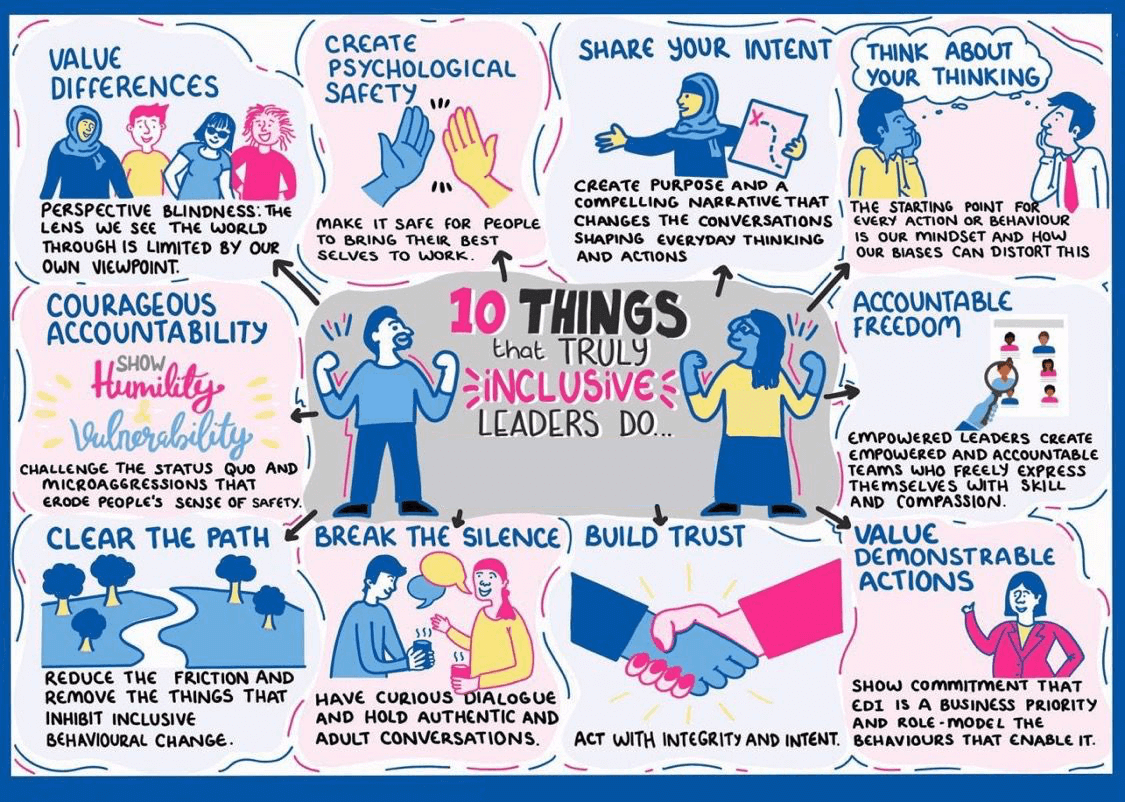
Communication is central to inclusion. Delegates consider language, listening, accessibility, different communication preferences and the importance of avoiding assumptions about individuals or groups.
The aim is not to create anxiety about saying the wrong thing, but to develop respectful habits, openness to feedback and the confidence to correct mistakes.
Inclusion also concerns who gets heard. Meetings and informal workplace networks can unintentionally favour confident, established or more senior voices.
Delegates explore simple techniques for widening participation and ensuring decisions benefit from a broader range of perspectives.
Leaders have particular responsibility for organisational culture, but inclusion is also shaped by everyday interactions between colleagues. Everyone can contribute by noticing exclusion, questioning assumptions, listening to different perspectives and treating others with respect.
The same confident voices dominate every discussion. How could participation be widened?
Team activities repeatedly suit some colleagues but unintentionally exclude others. What could the team do differently?
A colleague's capability or availability is assumed rather than discussed with them. What effect might this have?
By the end of the course, delegates should be better able to:
All our courses are tailored to ensure the training reflects your organisation's goals, workplace culture and priorities.
The course can be delivered face-to-face or online via Zoom or Teams.
To support participation, discussion and interaction, we recommend the following group sizes per session:
Need to train a larger workforce? No problem. We regularly work with organisations that need to train larger numbers of employees. Where appropriate, training can be delivered across multiple sessions to ensure everyone receives the same high-quality, interactive learning experience. We can develop a delivery programme to suit your workforce size, locations and timescales.
Please note: the half-day rate is not always available for face-to-face sessions.
Over 25 years' experience delivering equality, diversity and inclusion training, consultancy and professional development.
Keep updated with the latest equality and diversity news, offers and updates.